
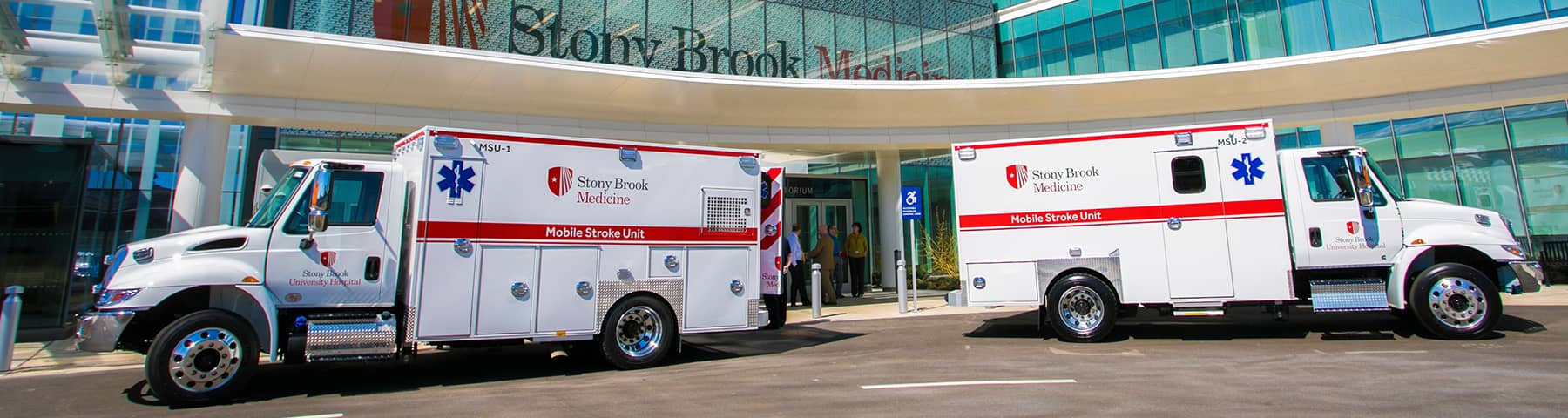
Long Island's Only Mobile Stroke Unit Program
Suffolk County residents have another good reason to look to Stony Brook Medicine for the highest level of care for both ischemic stroke and hemorrhagic stroke.
The faster blood flow can be restored to the brain, the more likely that a person will have a full recovery, making services provided by our Mobile Stroke Unit so important.
Perhaps you’ve heard the expression, “Time is brain.” It’s a reminder that when you have a stroke and the brain cannot get the blood and oxygen it needs, brain cells die rapidly. To put this in perspective, it’s estimated that when a blood vessel supplying the brain is blocked, nearly two million brain cells are lost for each minute that passes, making stroke one of the most time-sensitive diagnoses in medicine.
Our Mobile Stroke Units Make Brain-Saving Treatment Happen Faster
In 2019 we launched our Mobile Stroke Unit Program. And today, it’s still Long Island’s only program of its kind. Working in collaboration with 45 fire and emergency medical service (EMS) agencies that provide ambulance response in the communities we serve in Suffolk County, our mobile stroke unit team provides specialized, life-saving care to people within the critical moments of stroke, before they even get to the hospital.
This markedly reduces the time required to make an accurate stroke diagnosis, allows for time-sensitive stroke therapies to be administered early, and allows for the transport of stroke patients directly to the most appropriate hospital for the level of care they require, the first time.
An important milestone was reached on August 20, 2025, when a Stony Brook Mobile Stroke Unit was dispatched to its 10,000th call to service in Suffolk County for a suspected stroke. One year earlier, in 2024, the program marked its five-year anniversary with over 8,000 calls to service. Learn more about our important life-saving mobile stroke unit program.
Read firsthand accounts from patients and families who experienced care from our Mobile Stroke Unit below.
Gabrielle Neubert
While stroke seems unlikely for a 29-year-old, it happens more frequently than you’d think. Learn how Gabrielle’s plans to become a nurse practitioner and marry her fiancé Stephen in 2025 got quickly back on track thanks to Stephen’s quick thinking to call to 9-1-1, Stony Brook mobile stroke unit first responders, and the life-saving mechanical thrombectomy performed by Stony Brook cerebrovascular surgeon, Dr. Reza Dashti.

Peter Giordano, December 2022
On December 29, 2022, Pete Giordano was as happy as could be. The day before, he had submitted all his paperwork for his February 2023 retirement from his job with the Town of Hempstead.
Ralph Sabatino, April 2023
Ralph has high blood pressure. And his wife says he snores. The day Ralph’s stroke happened was typical, too…until it wasn’t. It was April 23, 2023. Ralph was working on his laptop in his bedroom.
Shashi Talwar, July 2022
Back home resting, after a routine visit to the hair salon, Shashi Talwar was chatting with her daughter, Richa Kalra, who is a trained nurse. The next thing Richa knew, her mom’s speech suddenly went haywire and her bottom lip shifted to one side.


Our Mobile Stroke Unit Program is available as a moment's notice, replying to calls seven days a week, from 8am to 8pm - the window of time when most stroke calls are received in Suffolk County. The mobile stroke unit team takes calls within a 10 mile radius of each base. We partnered with 45 emergency medical service (EMS) agencies throughout Suffolk County to provide this lifesaving, time-sensitive care.
A Mobile ER with Telehealth Capability
Each of our mobile stroke units is a mobile stroke emergency room (ER) with telehealth capability to Stony Brook Medicine's main hospital, Stony Brook University Hospital. This allows Stony Brook Medicine physicians at the hospital to determine, via a telehealth consult and through CT scans performed right onboard the mobile stroke unit by a trained stroke technician, if a person has a blocked vessel or bleeding in the brain.
Once that is determined, the stroke first responders onboard the mobile stroke unit can begin administering time-sensitive, advanced stroke treatments, when indicated, while the patient is en route to the nearest hospital that can provide the appropriate level of care.
Each Stony Brook Medicine mobile stroke unit is staffed with:
- A crew of stroke first responders, including a critical care nurse, paramedic, emergency medical technician (EMT) and computed tomography (CT) technologist.
- Medications, including a clot-buster medication that's administered intravenously.
- Brain imaging equipment, including a CT scanner that can perform both a standard head CT scan, as well as a CT scan angiogram (which looks at blood vessels throughout the body). These scans allow doctors back at our main hospital to immediately check for bleeding in the brain and determine whether a person has a blocked blood vessel, and immediately initiate treatment with clot-busting medications, when indicated.
- Stony Brook Medicine Telehealth’s teleneurology and teleneuroradiology services, which enable Stony Brook emergency physicians and neurologists to instantly see and examine a person via video conferencing and advise the mobile stroke unit’s crew en route to the hospital.
Improving the Chances of a Good Outcome
The Mobile Stroke Unit Program greatly improves the chances of a good outcome because it allows physicians at Stony Brook University Hospital to more rapidly identify if someone is a candidate for a mechanical thrombectomy, a procedure to remove clots that block large vessels.
The American Heart Association/American Stroke Association now recommends for selected acute ischemic stroke patients to receive mechanical thrombectomy as the standard of care. However, an individual must get to a hospital with physician experts and technology to perform a mechanical thrombectomy early enough to get the most benefit from the treatment. With the introduction of the Mobile Stroke Unit Program, more patients will be candidates for treatment if they are rapidly identified and transported to the nearest comprehensive stroke center early for these time-sensitive interventional therapies.
Keep in mind, if you have to call 9-1-1, you can request transport to a comprehensive stroke center.
David Fiorella, MD, PhD, neurointerventionalist and Director of the Stony Brook Cerebrovascular Center, has been performing mechanical thrombectomies for more than 20 years, and has witnessed the remarkable recovery of many individuals who arrived severely disabled and went home from the hospital independent and disability-free.
Mobile Stroke Unit: In the News
Stony Brook Mobile Stroke Unit Saves a Life: This revolutionary pre-hospital process markedly accelerates the time it takes doctors to make an accurate stroke diagnosis, allowing for time-sensitive stroke therapies to be administered earlier and the transport of stroke patients directly to the most appropriate hospital for the level of care they require, the first time.
